The pillar
Heartworm in the Mississippi Delta
The Delta sits in the highest incidence band in the country. What the incidence survey measures, why the Gulf concentrates it, and what follows.
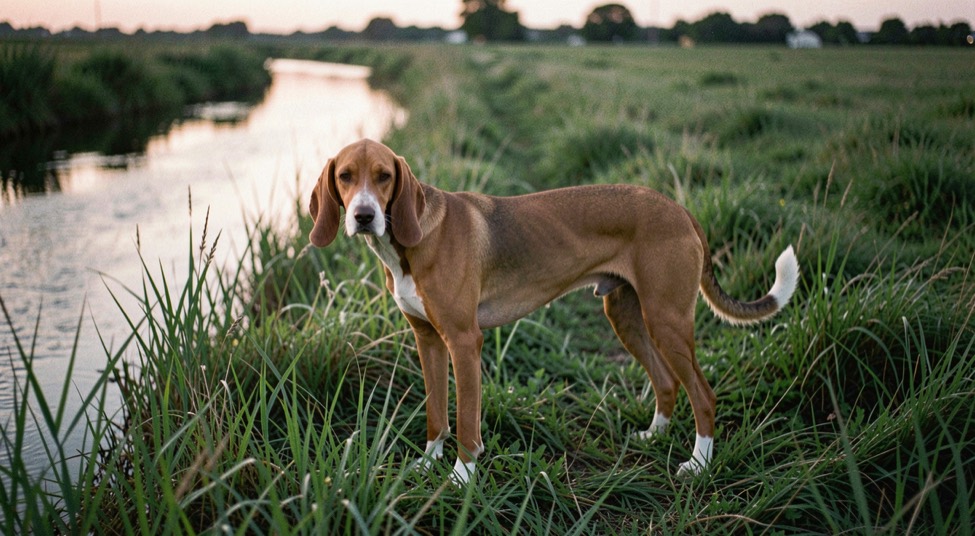
The Delta sits in the highest heartworm incidence band in the country, and the Gulf Coast concentrates the same pressure. The sentence is not a boast and not a guess: behind it stands the 2025 incidence survey of the American Heartworm Society, published in April 2026, the standing measurement of the disease in the United States. Mississippi reads in the top band of that survey, in the company of its neighbors, and this page unpacks what that fact is made of, what it asks of an owner, and what it does not say.
The same publisher's rhythm matters as much as its findings: the survey is rebuilt every few years from the reports of practicing clinics and shelters, and every health claim on this site carries the edition it came from. How the desk climbs from a printed figure back to its source is written in where the data comes from.
What the survey measures, and what it cannot
The 2025 survey drew on the reports of more than a thousand veterinary clinics and shelters, on more than a million dog tests. What it measures is what those reporters saw: the share of tests that came back positive, gathered clinic by clinic and rolled up into counties, states and a national picture. That scale is its strength. Its limit follows from the same fact: it is a survey of participation, not a census of dogs. A county with few reporting clinics reads quiet while being anything but; a county of diligent reporters can read loud. The number is a map of the disease seen through the clinics that reported, and the desk treats it exactly that way.
The 2025 reading, with its year
In the edition published in April 2026, five Southern states read at the top of the national table, in this order: Texas first, then Louisiana, Arkansas, Mississippi and South Carolina. The order matters less than the company: every state in the top band shares the same Gulf and lower Mississippi geography, the same long mosquito seasons, the same standing water. The Delta's presence in that band is the founding fact of dog keeping in this region, and the reason the prevention calendar here has no month off.
Why the Delta and the Gulf concentrate it
Heartworm travels by mosquito, so the map of the disease is the map of the mosquito's favorite country: warm, wet, and slow to drain. The Delta is flat river land, engineered for water to stand in; the Gulf Coast adds humidity and a winter too brief to reset the vector population. Onto that geography lay the dog population, including dogs that receive no prevention at all, each one a reservoir that keeps the local cycle fed. None of these ingredients is optional, and in this region none of them is seasonal for more than a few weeks at a time.
The worm's year, in plain words
The life cycle explains every rule that follows. A mosquito bites a dog already carrying the worms and picks up the microscopic young. Days later, that mosquito bites another dog and delivers them. The larvae migrate and mature slowly, over months, ending as adult worms in the heart and the lung vessels, where they live for years, quietly lengthening. From bite to detectable infection is a long arc, which is why the test is annual and why a lapse does not announce itself: the dog that skipped prevention this spring is not a sick dog this summer, and the bill arrives seasons later.
Test, prevention, and the arithmetic of skipping
The annual test is the frame, and the prevention decision belongs to the treating veterinarian: the product, the dose and the schedule are clinical questions, decided against the dog's file, not against a web page. What a page can carry is the arithmetic of skipping, in the qualitative form every Delta owner recognizes: the prevention is a monthly habit and a yearly test, and the treatment of an established infection is a long, confined, expensive convalescence measured in months of strict rest. The region's shelters know that arithmetic from the intake side; the adoption desk meets it in an adopted adult dog whose first month begins with the test.
The Gulf states as the survey reads them
| State | Its reading | The source |
|---|---|---|
| Texas | Reads first in the nation | American Heartworm Society, 2025 survey, published April 2026 |
| Louisiana | Reads second | American Heartworm Society, 2025 survey, published April 2026 |
| Arkansas | Reads third | American Heartworm Society, 2025 survey, published April 2026 |
| Mississippi | Reads fourth, with the Delta and the Gulf Coast as its foci | American Heartworm Society, 2025 survey, published April 2026 |
| South Carolina | Reads fifth | American Heartworm Society, 2025 survey, published April 2026 |
What the band does not say about your county
A state band is an average wearing a border, and the disease does not read borders. Within the top band states, the foci are local: the Gulf Coast, the lower Delta, the wet counties. For the picture at ground level, the Companion Animal Parasite Council publishes county level prevalence maps, updated continuously, and the same maps carry the tick borne diseases that share this climate; ehrlichiosis reads high across the Southeast and extends north of its old range. Two publishers, two scales, and a rule that never bends on this site: a health figure carries its publisher and its year, or it does not print. The county habit is part of the calendar laid out in year round prevention.
The Delta owner's standing questions
What the band asks, asked and answered yearly
Five questions that never leave the calendar.
- Is the annual test on the calendar, with its date, rather than in the memory?
- Is the prevention current this month, this exact month, not roughly?
- Has the lapse, if there was one, triggered the conversation before the resumption?
- Has the standing water in the yard been walked and dumped since the last rain?
- Is the county map's latest update checked, with its year noted?
Keeping this page honest
Every figure above carries its publisher and edition: the survey of the American Heartworm Society, 2025 reading published April 2026, and the county prevalence maps of the Companion Animal Parasite Council. The life cycle is described in plain words, without timelines precise enough to act on, because the acting belongs to the treating veterinarian. The next survey will move these numbers, and this page will move with them, dated.